

-----------KEEP FREE MEDIA FREE-----------
I segreti di Echolon (cosi' USA e Gran Bretagna ci tengono sotto controllo)
da New York Claudio Gatti
Controlli selvaggi (intervista all'eurodeputato britannico Glynn Ford)
da Bruxelles Raffaela Scaglietta
La vita e' tutto un file (tutti gli attentati alla privacy quotidiana)
di Perpaolo Bollani
(...)
Soltanto pochissimi addetti ai lavori sapevano pero' finora dell'esistenza
di una rete di monitoraggio globale di straordinaria capacita' ed
estensione che gli Stati Uniti gestiscono con la collaborazione di altri
quattro Paesi anglofoni - la Gran Bretagna, il Canada, l'Australia e la
Nuova Zelanda.
A rivelarlo ufficialmente e' un recentissimo rapporto del technological
option assessment (Stoa) della Direzione generale ricerca del Parlamento
Europeo secondo il quale ogni telefonata, ogni fax, ogni messaggio di posta
elettronica, criptato o meno, puo' essere intercettato, selezionato,
decodificato e inserito in una potentissima bancadati computerizzata comune
ai cinque PAesi in questione.
Nel descrivere questo meccanismo il rapporto, intitolato "Valutazione delle
tecnologie di controllo politico", non usa mezzi termini.: "In Europa tutte
le telefonate, i fax e i test di posta elettronica sono regolarmente
intercettati, e dal centro strategico inglese di Menwith Hill le
informazioni di interesse vengono trasferite al quartier generale della
NAtional Security Agency, l'agenzia di spionaggio elettronico americana".
IL PATTO UKUSA
Questa incredibile macchina aspira-comunicazioni battezzata Echelon e' il
frutto tecnologico piu' avanzato dell'Ukusa Strategy Agreement, un patto di
collaborazione nella raccolta di "Signal Intelligence" stretto nel 1948, la
cui stessa esistenza non e' mai stata ufficialmente confermata dai suoi
cinque partecipanti.
(...)
COME FUNZIONA
La particolarita' del sistema Echelon e' che la sua rete di satelliti, basi
terrestri e super-computer non e' disegnata soltanto per permettere
l'intercettazione di alcune particolari linee di trasmissione, bensi' per
intercettare indiscriminatamente quantitativi inimmaginabili di
comunicazioni via qualsiasi mezzo o lionea di trasmissione.
Il primo componente di questo sistema e' costituito dalle cinque grandi
basi Ukusa (...) da cui vengono intercettate le comunicazioni che passano
attraverso i 25 satelliti geostazionari Intelsat usati dalle compagnie
telefoniche di tutto il mondo per le comunicazioni internazionali (e che
trasmettono in chiaro, n.d.r.). A ogni singolo paese del patto (eccetto il
Canada) e' affidata la copertura di una particolare area del mondo.
La base che controlla l'intero traffico europeo sta in Inghilterra, a
Morwenstow, una localita' situata a 115 km a est di Exeter, sulle scogliere
del Cornwall.
Il traffico che va da nord a sud lungo il continente americano e'
sorvegliato invece dalla base di Sugar Grove, 250 km a sud-ovest di
Washnignton, nelle montagne della Virginia, mentre le telecomunicazioni sul
Pacifico sono divise tra l'altra base USA, all'interno del poligono del US
Army di Yakima, 250 km a sud-ovest di Seattle, la base neozelandese di
Waihopai e quella australiana di Geraldton, che copre anche l'Oceano Indiano.
La seconda componente della rete Ukusa e' costellazione di satelliti spia
che la Nsa ha messo in orbita a partire dal 1970 ed e' chiamata in codice
Vortex.
"L'ultima generazione di satelliti-spia e' costituita da tre nuovi 'bird'
geosincronici messi in orbita negli ultimi quattro anni, che da soli
coprono praticamente tutto il mondo", dice il massimo esperto del settore
Jeff Richelson.
Quello che copre l'Europa staziona in orbita a 22.300 miglia di altitudine
sopra il Corno d'Africa ed e' controllato dalla base terrestre inglese di
Menwith Hill, nel nord del Yorkshire, che con i suoi 22 terminali
satellitari e' di gran lunga la piu' grande e potente della rete Ukusa.
Il terzo e ultimo elemento del sistema Ukusa e' costituito da una griglia
di supercomputer in rete - battezzati "dizionari" - capaci di assorbire,
esaminare, e filtrare in tempo reale enormi quantita' di messaggi digitali
e analogici, estrapolare quelli contenenti ognuna delle parole-chiave
preprogrammate, decodificarli e inviarli automitacamente al quarteier
generale del servizio di intelligence dei cinque paesi interessati ai
messaggi che includono al parola predeterminata.
"Ogni pochi giorni i dictionary manager' dei cinque PAesi cambiano la lista
delle parole-chiave, inserendone delle nuove e togliendo delle vecchie a
seconda dei temi politici, diplomatici ed economici di interesse per gli
Usa e i suoi alleati", spiega Hager.
"E una volta inserite le parole e' solo questione di minuti prima che i
dizionarti comincino a sputar fuori messaggi che la contengono".
(...)
| IN THE LATE 1980S, IN A DECISION IT PROBABLY REGRETS, THE US PROMPTED NEW ZEALAND TO JOIN A NEW AND HIGHLY SECRET GLOBAL INTELLIGENCE SYSTEM. HAGER'S INVESTIGATION INTO IT AND HIS DISCOVERY OF THE ECHELON DICTIONARY HAS REVEALED ONE OF THE WORLD'S BIGGEST, MOST CLOSELY HELD INTELLIGENCE PROJECTS. THE SYSTEM ALLOWS SPY AGENCIES TO MONITOR MOST OF THE WORLD'S TELEPHONE, E-MAIL, AND TELEX COMMUNICATIONS. |
 |
| For 40 years, New Zealand's largest intelligence agency, the Government Communications Security Bureau (GCSB) the nation's equivalent of the US National Security Agency (NSA) had been helping its Western allies to spy on countries throughout the Pacific region, without the knowledge of the New Zealand public or many of its highest elected officials. What the NSA did not know is that by the late 1980s, various intelligence staff had decided these activities had been too secret for too long, and were providing me with interviews |
and
documents exposing New Zealand's intelligence
activities. Eventually, more than 50 people
who work or have worked in intelligence and
related fields agreed to be interviewed.
The activities they described made it possible to document, from the South Pacific, some alliance-wide systems and projects which have been kept secret elsewhere. Of these, by far the most important is ECHELON. |
Designed and coordinated by NSA, the ECHELON system is used to intercept ordinary e-mail, fax, telex, and telephone communications carried over the world's telecommunications networks. Unlike many of the electronic spy systems developed during the Cold War, ECHELON is designed primarily for non-military targets: governments, organizations, businesses, and individuals in virtually every country. It potentially affects every person communicating between (and sometimes within) countries |
|
anywhere in the world.
It is, of course, not a new idea that intelligence organizations tap into e-mail and other public telecommunications networks. What was new in the material leaked by the New Zealand intelligence staff was precise information on where the spying is done, how the system works, its capabilities and shortcomings, and many details such as the codenames. The ECHELON system is not designed to eavesdrop on a |
particular individual's e-mail or fax link. Rather, the system works by indiscriminately intercepting very large quantities of communications and using computers to identify and extract messages of interest from the mass of unwanted ones. A chain of secret interception facilities has been established around the world to tap into all the major components of the international telecommunications networks. Some monitor communications satellites, others land-based communications networks, and others radio communications. ECHELON links together all these facilities, providing the US |
and its
allies with the ability to intercept a large
proportion of the communications on the
planet.
The computers at each station in the ECHELON network automatically search through the millions of messages intercepted for ones containing pre-programmed keywords. Keywords include all the names, localities, subjects, and so on that might be mentioned. Every word of every message intercepted at each station gets automatically searched whether or not a specific telephone number or e-mail address is on the list. |
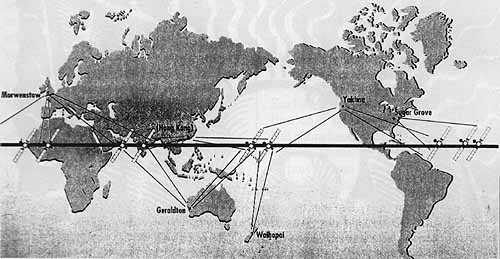
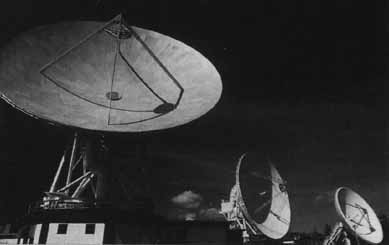
Six UKUSA station target Intelsat satellites
used to relay-and to intercept-most of the
world's e-mail,fax, and telex communications.
|
The thousands of simultaneous messages are
read in "real time" as they pour into the
station, hour after hour, day after day, as
the computer finds intelligence needles in
telecommunications haystacks.
SOMEONE IS LISTENING |
keywords have existed since at least the 1970s, but the ECHELON system was designed by NSA to interconnect all these computers and allow the stations to function as components of an integrated whole. The NSA and GCSB are bound together under the five-nation UKUSA signals intelligence agreement. The other three partners all with equally obscure names are the Government Communications Headquarters (GCHQ) in Britain, the Communications Security Establishment (CSE) in Canada, and the Defense Signals Directorate (DSD) in Australia. | The alliance, which grew from cooperative efforts during World War II to intercept radio transmissions, was formalized into the UKUSA agreement in 1948 and aimed primarily against the USSR. The five UKUSA agencies are today the largest intelligence organizations in their respective countries. With much of the world's business occurring by fax, e-mail, and phone, spying on these communications receives the bulk of intelligence resources. For decades before the introduction of the ECHELON system, the UKUSA allies did intelligence |
|
collection operations for each other, but each
agency usually processed and analyzed the
intercept from its own stations.
Under ECHELON, a particular station's Dictionary computer contains not only its parent agency's chosen keywords, but also has lists entered in for other agencies. In New Zealand's satellite interception station at Waihopai (in the South Island), for example, the computer has separate search lists for the NSA, GCHQ, DSD, and CSE in addition to its own. Whenever the Dictionary encounters a message |
containing one of the agencies' keywords, it
Every word of every message intercepted at each station gets automatically searched- whether or not a specific telephone number or e-mail address is on the list. automatically picks it and sends it directly |
to the headquarters of the agency concerned.
No one in New Zealand screens, or even sees,
the intelligence collected by the New Zealand
station for the foreign agencies. Thus, the
stations of the junior UKUSA allies function
for the NSA no differently than if they were
overtly NSA-run bases located on their soil.
The first component of the ECHELON network are stations specifically targeted on the international telecommunications satellites (Intelsats) used by the telephone companies of most countries. A ring of Intelsats is |
|
positioned around the world, stationary above
the equator, each serving as a relay station
for tens of thousands of simultaneous phone
calls, fax, and e-mail. Five UKUSA stations
have been established to intercept the
communications carried by the Intelsats.
The British GCHQ station is located at the top of high cliffs above the sea at Morwenstow in Cornwall. Satellite dishes beside sprawling operations buildings point toward Intelsats above the Atlantic, |
Europe, and, inclined
almost to the horizon, the Indian Ocean. An
NSA station at Sugar Grove, located 250
kilometers southwest of Washington, DC, in the
mountains of West Virginia, covers Atlantic
Intelsats transmitting down toward North and
South America. Another NSA station is in
Washington State, 200 kilometers southwest of
Seattle, inside the Army's Yakima Firing
Center. Its satellite dishes point out toward
the Pacific Intelsats and to the east.
The job of intercepting Pacific Intelsat communications |
that cannot be intercepted at
Yakima went to New Zealand and Australia.
Their South Pacific location helps to ensure
global interception. New Zealand provides the
station at Waihopai and Australia supplies the
Geraldton station in West Australia (which
targets both Pacific and Indian Ocean
Intelsats).
Each of the five stations' Dictionary computers has a codename to distinguish it from others in the network. The Yakima station, for instance, located in desert country |
| between the Saddle Mountains and Rattlesnake Hills, has the COWBOY Dictionary, while the Waihopai station has the FLINTLOCK Dictionary. These codenames are recorded at the beginning of every intercepted message, before it is transmitted around the ECHELON network, allowing analysts to recognize at which station the interception occurred. | New Zealand intelligence staff has been closely involved with the NSA's Yakima station since 1981, when NSA pushed the GCSB to contribute to a project targeting Japanese embassy communications. Since then, all five UKUSA agencies have been responsible for monitoring diplomatic cables from all Japanese posts within the same segments of the globe they are assigned | for general UKUSA monitoring. Until New Zealand's integration into ECHELON with the opening of the Waihopai station in 1989, its share of the Japanese communications was intercepted at Yakima and sent unprocessed to the GCSB headquarters in Wellington for decryption, translation, and writing into UKUSA-format intelligence reports (the NSA provides the codebreaking programs). |
next page